I graduated from my bachelors in January of 20131, my institute prided itself in orthodox art/design education. Being a millennial I’m also acutely situated in that age range that experienced both the rise and fall of floppy disks and answering machines as well as the obsession with smart technologies and AI to the point of exhaustion. Design as both a practical means of applying logic with aesthetics and as a process for problem solving, has played a pivotal role in perhaps leading to my decision for pursuing it as a career. That brings me to being a tutor in this discipline and the opportunity I have been provided to observe its evolution amongst a newer generation of creatives in an education-focused role. What I question is if the changes towards design pedagogy have been beneficial?
Here’s my gripe, and I have encountered this too many times where students avoid the practical nature of design in favour for its ease of application. I keep returning to my students with the same feedback, “Where is the process?” By jumping into the practical application of design students are ignoring the heavily process driven nature of the discipline. For a while this nagged at me until recently after an industry focus group for new degree pathways it was reinforced when unanimously I was informed how fresh graduates don’t know how to critique, discuss, or even sell their own work. The storytelling aspect of the design skillset has diminished and I believe this is directly related to the avoidance of process. This should be nothing new to anyone teaching design, and a comment I keep getting back from my tutors is the same that students are probably lazier now. COVID-19 didn’t help in this regard and if anything it presented further avenues for design as a discipline to evolve into with some positive directions such as advancements in collaboration tools (Miro, Zoom, Figma, etc.), but also presented a justification for not designing in situ any more (such as Miro, Zoom, Figma, etc.).
Warning! Old-man history lesson approaching
Now back in my day we were required to understand the fundamentals of design irrespective of how we intended to apply them. NCA kept things simple and design was presented as either communication design, textile/fashion design, or product design (with a branch into ceramics for those passionate). There is a certain beauty to this simplicity that is reminiscent of the Bauhaus, and no doubt the inspiration for how curriculum was designed at NCA back then definitely came from movements such as the Bauhaus coupled with impressionist and colonial influences of South Asian Art and Design. I’m glad it did, because I was in a cohort that learned in a multidisciplinary collaboration with students who wanted to become many great things from humble beginnings. Some of those students have lived up to the expectations of my college and by extension the expectations of the apprentices of Old Masters from the Mughal court who were among the first tutors of the institute.
I wasn’t originally in design,2 shifted my journey to fine arts and graduated in printmaking but everyone had to go through the fundamentals together irrespective of what they would explore ahead as their majors. The orthodox nature of this formal education translated into an expanded world view when I moved into design in industry. Graphic design was no longer understood just through pixels, it was understood through mixing ink on glass palettes and feeling the texture of paper. This was a phenomenal way of understanding design, the limitations presented to me through my pedagogy made me want to seek out logical solutions and address complexity.
For instance, In the first few weeks of art school I recall making my initials as a three dimensional cardboard model in class. Working with design elements/principles we understood how they applied to these odd shape. The task felt tedious and required learning model making and understanding design principles within the same four hour period. The time crunch and seemingly vague nature of the task collectively had us all thinking why this was necessary; when will we ever do this in industry? There was an unconscious learning that we experienced and only realised later towards the end of our time there. Years later I am reminded of that simple task after seeing students struggle with the basics of design. While I implemented that same exercise in a course I convened later at UNSW, it did not have the same impact as I had expected.
I wonder now of what the magical formula was at NCA that brought together an experience of learning that felt meaningful? I do recall having similar sentiments (as many of my students do) at the time of doing those vague and obscure assessments expected of us in my undergraduate, so perhaps time is one such ingredient in this magic?
Kasb-e-kamal kun ke Aziz-e-Jahan shavi
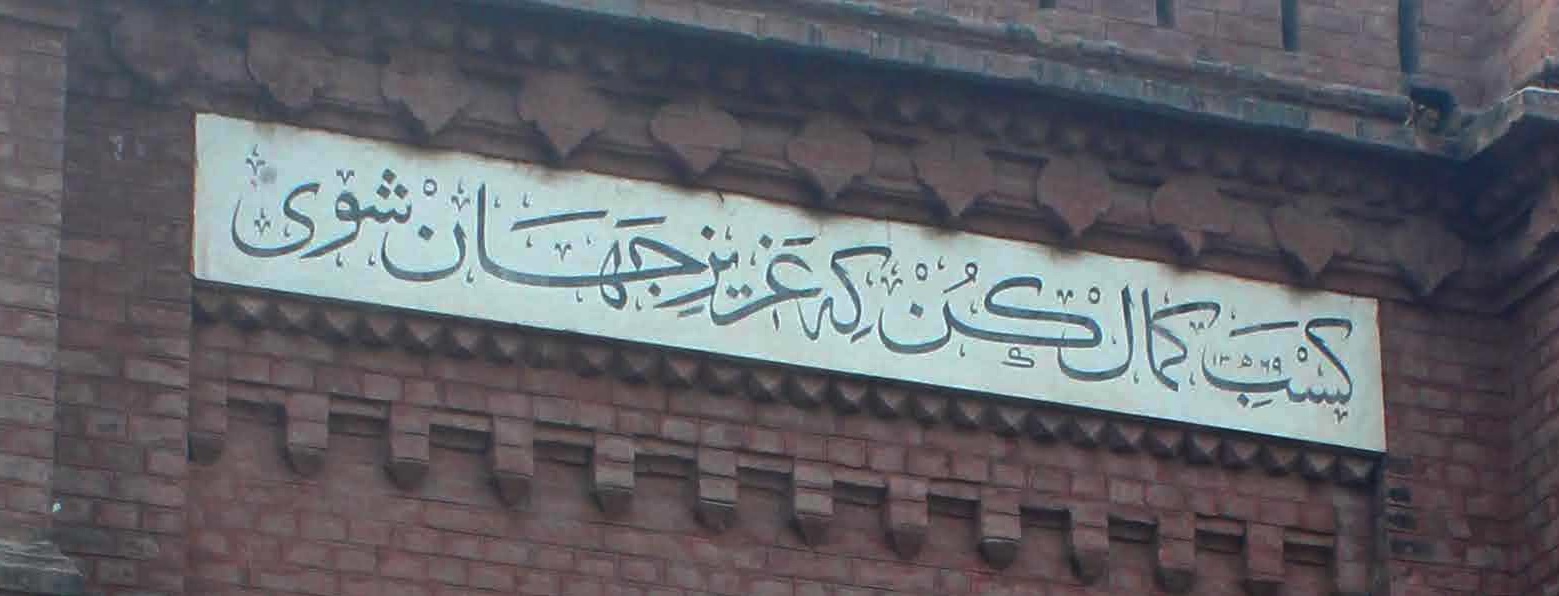
This was the motto for NCA and still is to this day. An institute that has seen the partition of the sub-continent, multiple terrorist threats, societal revolutions, and torrential political adversity has stood the test of time as a place for learning and liberal discussion. We heard stories from my tutors of how religious fanatics used to protest outside the college and even embed themselves into classrooms to disrupt because they didn’t agree with the liberal anti-establishment ideals of our learning. This motto is engrained in every student from our first day at college. It’s farsi and stands for: Seek excellence in your work, so you can be admired by the world. It reaffirmed to us that no matter what social or political adversity the college would face it was proud of its ideals.
The way the arts were taught to us made us want to seek that excellence in ourselves by exploring who we were as individuals and infusing that into our work. I worry if the lacklustre attitude of students today is because excellence is no longer sought after in ones work, or if admiration is no longer a necessity. I certainly see my students admiring the works of others, so I wonder why that admiration is not present among themselves?
Pedagogy matters. I’ve been through different forms of education between Pakistan, U.A.E, UK, and now Australia. I’ve seen the gamut of Eastern vs Western education systems and the models are completely different. Eastern education follows ideals of inclusion, growth, and individuality while Western models focus on capitalist ideals where students are a metric that needs to be increased. The difference is very clear in the staff meetings, in NCA it was about what are we going to teach this term compared to the last, there was a sense of self-improvement and shared growth. At UNSW it is as I would expect other Western institutes to follow, a discussion of enrolment metrics and comparisons against other schools. The competition is what always gets me, we never felt the need to compete at NCA. Perhaps that’s what a legacy of 150+ years leads to, UNSW is 70+ in comparison, but it does make me wonder if institutes like Oxford and Cambridge also follow this same format?
Pedagogy is influenced by such things which is why it matters. It trickles down into our course structures, assessment designs, and ultimately learning opportunities for students. The methods I learned by seem irrelevant today or classed as outdated. Granted, some do feel archaic though when I recall those experiences with colleagues they find it inspiring yet student’s not so much. For instance, as part of learning fine arts at NCA we had to complete all the major blocks before landing on a method we would carry forward as our major; painting, printmaking, miniature painting, or sculpture were our options. This model is similar to what the Bauhaus had and typically considered an orthodox learning experience.
Miniature in particular comes to mind since it was taught to us the same way it was always taught from the time of the Mughal court taking on the mentor-apprentice model. This meant making out own brushes from scratch, mixing paint in seashells to take advantage of natural calcium binders, prepare our own surfaces or wasli a stacked paper surface prepared with dough using natural gluten as gum, and more. There was an association that developed with the medium and craft in this manner. We would sit on the floor and paint in an almost meditative manner, it was always calming and that was needed of a miniature painter.
I can’t imagine many of these methods being exercised on our students today, not even sure how much of it will be appreciated let alone passed through regulations and policies. Sometimes it just leaves me to wonder if creative education has changed this much? Or is it simply a new form of creativity for a new era of creatives? Either way, it leaves me as an educator feeling like something is left out. Are my students seeking that excellence in their work I expect them to? Are they hoping to be admired by the world? Or are they simply hoping to be pushed into a capitalist machine, the creep of industry in creative education is very real though I also find it ironic how they want storytellers of yore yet they have established a system that makes storytelling and these creative processes redundant.
One can only wonder, where/when did things change?
-
Technically December 2012 but at NCA we have an exhibition which officially marks graduation ↩︎
-
I had originally wanted to join NCA’s design cohort but failed my first attempt. My second attempt was successful in fine arts with the hopes of shifting into design later. I had later learned my first rejection was because I had already been practising freelance design and the panel did not think it was worth my time to learn more design, in fine arts though they saw potential. I wonder whether this logic remains when students are selected for Western universities? ↩︎